sabato 10 marzo 2012

f. Verona, La città degli innamorati

f. Verona, Lovers’ City


La Casa di Giulietta è un palazzo medievale di Verona, situato in via Cappello, a poca distanza dalla centrale piazza delle Erbe.

The House of Juliet in Verona is a medieval building, located in Via Cappello, not far from Piazza delle Erbe.


La Scala della Ragione, si trova all’interno del Cortile del Marcato Vecchio proprio di fronte a Piazza dei Signori. Si tratta di una scale quattrocentesca, un gioiello tardogotico costruito in marmo rosso veronese.

The “Scala della Ragione”, is located inside Marcato Vecchio courtyard right in front of Piazza dei Signori. It is a fifteenth-century staircase, an International Gothic jewel built in red marble of Verona.


Al centro di Piazza dei Signori si trova il monumento a Dante Alighieri, realizzato nel 1865 per celebrare il sesto centenario della nascita del poeta, che durante il suo esilio da Firenze fu ospite a Verona. Si tratta di una splendida statua in marmo, alta tre metri e sorretta da piedistallo in cui Dante, volgendo le spalle a via delle Fogge, ha la testa leggermente girata verso il palazzo di Cansignorio.

In the middle of Piazza dei Signori there is the monument to Dante Alighieri, made ​​in 1865 to celebrate the sixth centenary of the poet’s birth, who during his exile from Florence lived in Verona. It is a beautiful marble statue, three meters high.


Sbandieratori in Piazza dei Signori.

Nel 2010 Verona è stata sede del XXX° CAMPIONATO ITALIANO SBANDIERATORI E MUSICI, si sono sfidati i migliori gruppi sbandieratori d’Italia per contendersi il titolo di campioni nazionali con spettacolari esibizioni dal sapore antico.

Flag throwers in Piazza dei Signori.

In 2010 Verona was the hosting city of the XXX Italian Championship of flag throwers and Musician, the best Italian flag-throwers group have challenged contending the title of national champions with spectacular performances.


Immagini  © 2012 Rimoldi Marco L’intero album con le immagini di questo post è disponibile su Picasa Web Album.


Pictures  © 2012 Rimoldi Marco The complete album is available on Picasa Web Album.


domenica 19 febbraio 2012

34. Passare una notte al Grand Hotel et de Milan, nella suite in cui Verdi visse l'ultimo quarto del 1800

34. Spend a night at the Grand Hotel et de Milan, in the suite where Verdi lived the last quarter of 1800s


Il Grand Hotel et de Milan si trova in via Manzoni all’angolo con via Montenapoleone.

Per raggiungerlo vi consiglio di partire dalla Galleria, passare di fronte alla Scala e proseguire per via Manzoni. In questo modo potrete percorrere lo stesso tragitto che il maestro Giuseppe Verdi percorreva ogni giorno di ritorno dal teatro.

Il Grand Hotel et de Milan fu infatti la sua dimora nell’ultimo quarto del diciannovesimo secolo dove morì il 27 gennaio 1901.

The “Grand Hotel et de Milan” is located in Via Manzoni at the corner with Via Montenapoleone.

To get there, I recommend passing from the Gallery, passing in front of the “Scala” and continue on Via Manzoni. In this way you can travel the same route “Il Maestro” Giuseppe Verdi ran through daily returning from the theater.

The Grand Hotel et de Milan was in fact his home in the last quarter of the nineteenth century, where he died January 27, 1901.


Verdi fu ospite nella suite 105, che conserva ancora arredamenti e strutture originali (nonostante i gravi danni subiti dall’albergo durante i bombardamenti della II Guerra Mondiale).

Ovviamente non è possibile alloggiare presso la suite 105 e salvo rare eccezioni non è nemmeno aperta al pubblico.

Verdi was guest in the suite 105, which still has original furnishings and structures (despite the severe bombing damage of the World War II).

Obviously you cannot sleep in the 105 suites and, with rare exceptions, it is not even open to the public.


Una di queste rare eccezioni sono le Giornate di Primavera del FAI (Fondo Ambiente Italiano), durante le quali i soci del fondo possono effettuare una visita guidata alla suite.

One of these rare exceptions are the FAI’s Days of Spring (National Trust of Italy), during which members of the National Trust can take a guided tour to the suite.

La stanza attualmente è divisa in una zona giorno e una zona notte. Nella zona giorno è presente lo scrittoio sul quale vennero composti l’Otello e il Falstaff.

The room is currently divided into a living area and sleeping area. In the living area there is the desk on which were composed the Otello and the Falstaff.


Verdi non fu l’unico a scegliere questo Hotel come sua residenza, dopo di lui vi soggiornarono tra gli altri, Caruso, il quale nella stanza 306 registrò uno dei primi dischi della storia della musica, Gabriele D’Annunzio e Maria Callas.

Verdi was not the only one to choose this hotel as his residence, after him stayed here among others, Caruso, who in room 306 recorded one of the first records in the history of music, Gabriele D'Annunzio and Maria Callas.

Immagini  © 2012 Rimoldi Marco L’intero album con le immagini di questo post è disponibile su Picasa Web Album.

Creative Commons License Alcune parti del testo derivano da una riproduzione o una modifica del testo delle rispettive voci di Wikipedia, pertanto l’intero testo è disponibile secondo la Licenza Creative Commons.

Pictures  © 2012 Rimoldi Marco The complete album is available on Picasa Web Album.

Creative Commons License Some parts of the text are a reproduction or a text editing from the respective Wikipedia article, so the entire text is available under the Creative Commons License.

domenica 5 febbraio 2012

20. Sentirsi a Roma in via Brisa

20. Feeling in Rome, in via Brisa


A Roma, si sa, l’intera città è disseminata di resti dell’epoca romana. E’ sufficiente girare per la città per fare un tuffo nella storia.

Milano invece mostra pochissimo della sua storia più antica. Delle tracce si possono trovare al Museo Archeologico, o negli altri musei civici.

Milano è stata distrutta e ricostruita più e più volte. Ogni volta anziché guardare al passato si pensava al futuro.

In via Brisa però sono ancora visibili i resti della dell’antica Mediolanum.

In Rome, everyone knows, the entire city is scattered with ruins from Roman times. And simply going round the city it is possible to take a dip in history.

Milan, however, shows very little of its ancient history. Traces can be found in the Archaeological Museum or in other civic museums.

Milan was destroyed and rebuilt many times. Every time thinking at the future instead of looking at the past.

Nevertheless in “Via Brisa” are still visible remains of the ancient Mediolanum.

Si tratta dei resti del Palazzo Imperiale romano di Milano un'antica struttura costruita al tempo dell'Augusto Massimiano (dopo il 291 circa) quando fece di Mediolanum la propria capitale dell'Impero romano d'Occidente.

These are the remains of the Roman Imperial Palace of Milan an ancient structure built at the time of the August Maximian (after about 291) when he set up in Mediolanum the capital of the Western Roman Empire.

Immagini  © 2012 Rimoldi Marco L’intero album con le immagini di questo post è disponibile su Picasa Web Album.

Creative Commons License Alcune parti del testo derivano da una riproduzione o una modifica del testo delle rispettive voci di Wikipedia, pertanto l’intero testo è disponibile secondo la Licenza Creative Commons.

Pictures  © 2012 Rimoldi Marco The complete album is available on Picasa Web Album.

Creative Commons License Some parts of the text are a reproduction or a text editing from the respective Wikipedia article, so the entire text is available under the Creative Commons License.

martedì 3 gennaio 2012

17. Farsi una memorabile scorpacciata di pesce crudo

17. Make a memorable feast of raw fish

A Milano la ristorazione giapponese ha avuto un vero e proprio boom negli ultimi dieci anni.

Questa volta ho deciso di non seguire i consigli che Micol da nel libro, ma ho fatto di testa mia.

L’intenzione era quella di provare il miglior giapponese di Milano. Mi sono quindi affidato ai giudizi degli utenti di Tripadvisor.

In Milan, the Japanese food had a real boom in the last ten years.

I decided to not follow Micol’s advice from the book, but I did on my own.

The idea was to try the best Japanese restaurant in Milan. I rely on the Tripadvisor users reviews.

La scelta è caduta sul ristorante Yokohama, che si trova in via Maurizio Gonzaga all’angolo con Piazza Diaz, praticamente a due passi dal Duomo.

Dopo una prima esperienza, qualche tempo fa, ero scettico sulla cucina Giapponese. Dopo questa esperienza posso soltanto dire una cosa: Ottimo!!

The choice fell on the Yokohama restaurant, located on Maurizio Gonzaga street, two minutes walk from the Duomo.

After my first experience, some time ago, I was skeptical about Japanese cuisine. After this experience I can only say one word: Great!!

Immagini  © 2011 Rimoldi Marco L’intero album con le immagini di questo post è disponibile su Picasa Web Album.

Creative Commons License Alcune parti del testo derivano da una riproduzione o una modifica del testo delle rispettive voci di Wikipedia, pertanto l’intero testo è disponibile secondo la Licenza Creative Commons.

Pictures  © 2011 Rimoldi Marco The complete album is available on Picasa Web Album.

Creative Commons License Some parts of the text are a reproduction or a text editing from the respective Wikipedia article, so the entire text is available under the Creative Commons License.

sabato 24 dicembre 2011

16. Un giro di shopping alla Rinascente

16. Rinascente shopping tour

La Rinascente di Milano è la Rinascente per eccellenza. Si trova sul lato sinistro del Duomo.

The Milan Rinascente it is the Rinascente for excellence. It is located on the left side of the Duomo.


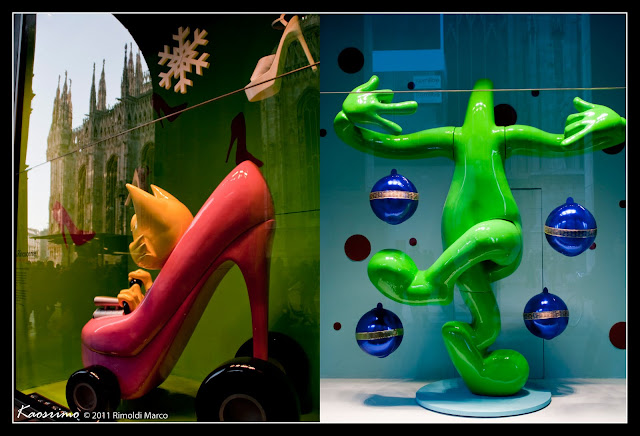
Le vetrine della Rinascente sono diventate una sorta di monumento al cool.  Sono da sempre mitologia milanese, immense e generalmente bislacche.

The shop windows of the Rinascente have become a sort of monument to cool. They has always been Milanese mythology. They are huge and generally outlandish.


Ma perché Rinascente?

Nel 1865 i fratelli Luigi e Ferdinando Bocconi aprirono in via Santa Radegonda a Milano il primo negozio italiano in cui erano venduti abiti pre-confezionati.

Nel 1917 Senatore Borletti rilevò l'attività, puntando sull'eleganza dei grandi magazzini e impegnandosi immediatamente ad aumentare la qualità della merce venduta, pur senza alzare eccessivamente i prezzi. Lo scopo annunciato era un approccio "democratico" al mercato, ossia attirare sia clienti delle classi alte che di quelle medio-basse. Per aumentare la fruibilità del grande magazzino di piazza Duomo, questo venne arricchito di numerose attività di uso comune, fra cui una banca e un ufficio postale.

Gabriele D'Annunzio nel 1917 l'aveva ribattezzata La Rinascente dopo la ricostruzione seguita all'incendio che l'aveva completamente distrutta e l'azienda divenne un luogo di ritrovo di molti artisti. Ad esempio la pubblicità veniva realizzata da Marcello Dudovich, mentre una linea di mobili fu firmata da Gio Ponti.

Why “La Rinascente”?

The Bocconi brothers opened a first clothing shop named Aux Villes d'Italie in Via Santa Radegonda (next to Piazza del Duomo, Milan) in 1877, inspired. The business grew very quickly and within few years they opened stores in several more Italian cities. People were attracted by the then-new concept of exposing the clothes in plain sight and allowing customers to walk around the shop and "watch and desire". The Bocconi brothers, however, failed to support this advantage with a targeted commercial strategy, so the success was relatively short-lived. The onset of World War I worsened the decline and by 1917 the chain of stores was about to go out of business.

Instead the Bocconi brothers sold to entrepreneur Senatore Borletti, who went looking for ideas to relaunch the business. He hired decadent poet Gabriele d'Annunzio, arguably the most influential figure in the Italian culture at the time, to suggest a new public image for the store. The poet suggested La Rinascente (i.e. "she who is born again") as the new name, to symbolize the rebirth of the store but also, and more significantly, the rebirth of Italy at the end of a war which was causing widespread poverty. On Christmas night, 1918 - the first Christmas in peacetime - a short circuit caused the renovated main store in Piazza del Duomo to burn to the ground. When it opened again after being rebuilt, the name had a new meaning besides the original: that of a place which had been literally "born again" from its ashes.

The Borletti family kept ownership of the chain until the late Sixties. The stores have since kept the name suggested by d'Annunzio and are still very popular today among Italian citizens and tourists.


Non vi resta che farci un giro. Si parte dal basso con l’ingresso superscenografico, qui vi trovate tutti gli stand delle griffe di profumi, trucchi e cosmetica. E poi via sulle scale mobili a visitare tutti i piani del megastore.

The only thing you need to do now is a store tour. It starts from the bottom with the super scenographic entrance, here you will find the stands of the major perfume, makeup and cosmetics brands. And then on the escalator to visit all the floors of the megastores.


Ovviamente troverete di tutto, casalinghi, abiti da uomo, donna, bambino. In fine la vera sorpresa è l’ultimo piano, dedicato al cibo sia da acquistare ,sia da consumare vista Duomo.

Of course you will find everything, housewares, clothing for men, women and children. The real surprise is the last floor dedicated to food. You could buy it or eat it directly viewing the Duomo.

Immagini  © 2011 Rimoldi Marco L’intero album con le immagini di questo post è disponibile su Picasa Web Album.

Creative Commons License Alcune parti del testo derivano da una riproduzione o una modifica del testo delle rispettive voci di Wikipedia, pertanto l’intero testo è disponibile secondo la Licenza Creative Commons.

Pictures  © 2011 Rimoldi Marco The complete album is available on Picasa Web Album.

Creative Commons License Some parts of the text are a reproduction or a text editing from the respective Wikipedia article, so the entire text is available under the Creative Commons License.